.png)


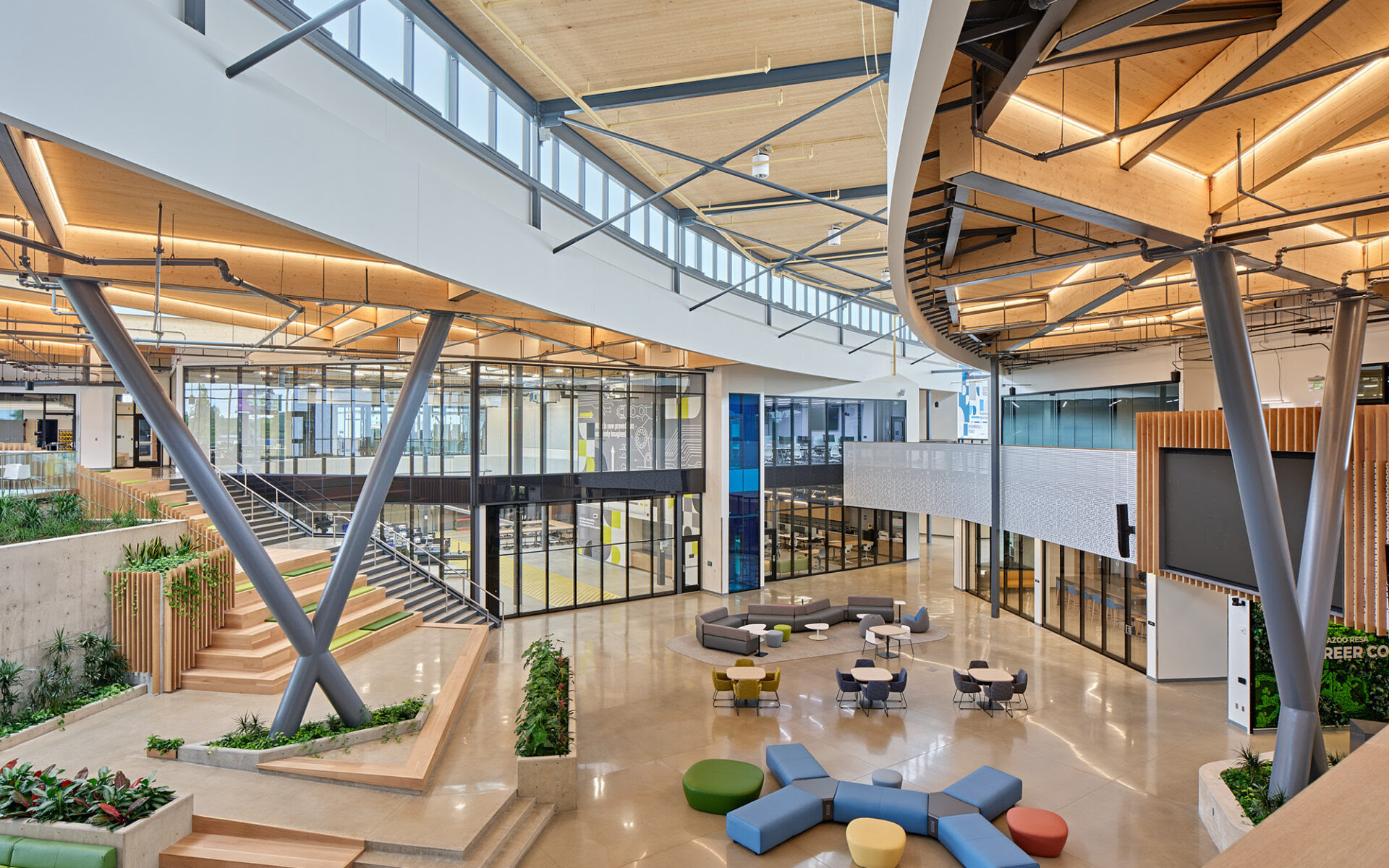
Last week, our team had the opportunity to tour the KRESA Career Connect Campus in Kalamazoo as part of a regional Mass Timber in Design workshop. Seeing a mass-timber building of this scale in person reinforced something we’ve been hearing more and more across Michigan: mass timber is no longer theoretical-it’s here, it’s working, and it’s being built right now.
Why KRESA matters
KRESA’s Career Connect Campus is a powerful real-world example of how mass timber can support both performance and purpose. The exposed glulam beams and CLT decking are not hidden behind finishes-they’re part of the learning environment itself. Natural light, warmth, and openness are immediately apparent the moment you walk inside.
Beyond aesthetics, the building demonstrates how hybrid mass timber systems can be integrated with steel to meet structural, schedule, and code requirements-an approach that is becoming increasingly relevant for institutional and educational projects.
Mass timber, explained in plain terms
Sandra Lupien, Director of MassTimber@MSU, did an excellent job grounding the conversation in practical terms. She often describes mass timber as panelized, engineered wood products designed at building scale, not traditional stick framing. The construction analogy she shared resonated strongly:
Mass timber components arrive prefabricated and ready to assemble-“almost like an erector set.”
For owners and builders alike, that translates to greater predictability, tighter schedules, and fewer on-site variables—especially valuable in projects where coordination and timeline matter.
Addressing the fire question head-on
One of the most common concerns we hear is fire performance. Lupien explained that mass timber behaves differently than conventional lumber: when exposed to fire, the outer layer chars and creates a protective barrier, helping preserve the structural core. This performance characteristic is well documented and is a key reason mass timber continues to gain approval across building codes and jurisdictions.
What’s Next: Western Michigan University’s Mass-Timber Dorm

Momentum is clearly building. A major sign of that is the new mass-timber residence hall currently underway at Western Michigan University. The project reflects a growing confidence in mass timber for student housing, where speed, durability, and long-term operational value are critical.
University dorms are a particularly strong fit for mass timber:
Accelerated construction schedules help campuses meet enrollment demands
Lower embodied carbon aligns with institutional sustainability goals
Warm, biophilic interiors support student well-being and experience
Seeing WMU commit to mass timber signals that this construction approach is moving firmly into the mainstream Midwest market, not just coastal pilot projects.
Our takeaway
The KRESA tour and the WMU dorm project tell a consistent story: Michigan is positioning itself as a serious leader in mass timber. With a strong forestry economy, engaged academic partners, and real projects breaking ground, the conversation has shifted from “if” to “where does it make sense?”
For builders, owners, and designers willing to think collaboratively, mass timber offers a compelling mix of sustainability, constructability, and long-term value—and we’re excited to stay at the table as these projects continue to take shape.
For more details on Western Michigan University’s mass timber residence hall and its progress, you can check out WMU’s official update